

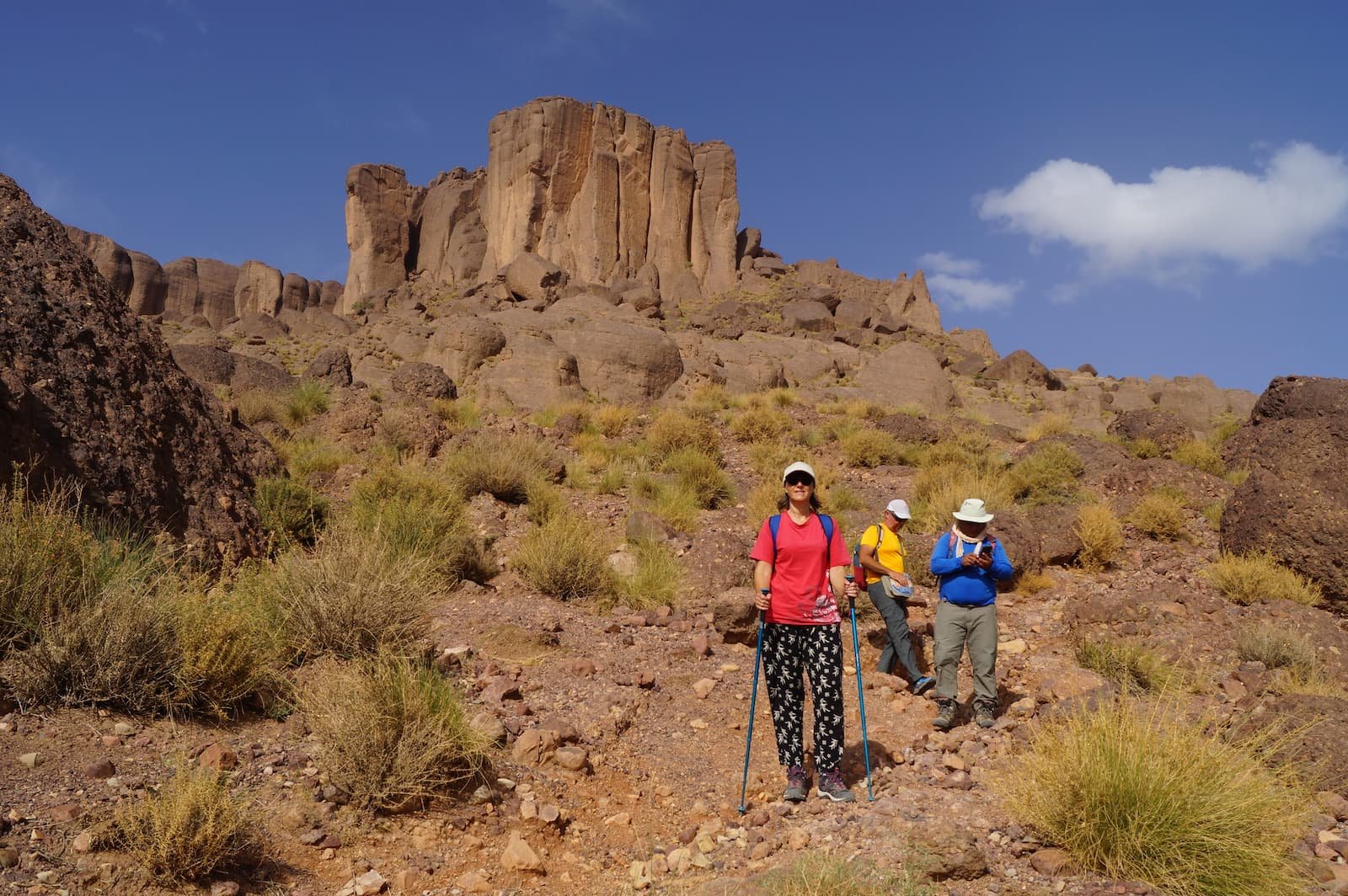
Jbel Saghro is a volcanic range between the High Atlas and the Sahara and the best place in Morocco to trek in winter: from October to April the days are usually mild, around 15–25°C, while the Atlas summits are under snow. A 5-day trek from Marrakech covers the heart of the range around the rock towers of Bab n’Ali, while a 7-day route adds the Kouaouch summit (about 2,600 m) and a fuller crossing of the massif.
Key takeaways
- Best months: October to April; avoid June to August, when the heat can pass 35°C.
- Landscape: ancient volcanic rock carved into spires, mesas and gorges, with small oases and the twin pinnacles of Bab n’Ali.
- People: the Saghro is the homeland of the Ait Atta, Amazigh herders who still move their flocks with the seasons.
- Routes: 5 days for a loop from Nkob via Bab n’Ali; 7 days for a traverse from Tagdilt to N’Kob with the Kouaouch summit.
- Level: moderate, with 4.5–6.5 hours of walking a day on rocky but non-technical paths; mules carry the luggage.
Where is Jbel Saghro?
Jbel Saghro (also spelled Sarhro or Saghrou) rises south of the Dades valley and north of the Draa, at the eastern end of the Anti-Atlas. It is lower and drier than the High Atlas: its highest point, Amalou n’Mansour, reaches 2,712 m, and most trekking routes stay between roughly 1,500 and 2,600 m. Kasbah villages such as N’Kob line its southern foot, while Tagdilt gives access from the Dades side.
From Marrakech, the drive crosses the High Atlas by the Tizi n’Tichka pass (2,260 m) and continues past Ouarzazate, taking around six to seven hours with stops. The first and last days of any Saghro trek are therefore mostly travel days, with plenty to see on the way, from the palm groves of the Draa valley to the kasbahs of the south.
Why trek Jbel Saghro?
A true winter trekking destination
When snow closes the high passes of the Atlas, the Saghro is at its best. Winter brings clear skies, crisp air and comfortable walking temperatures, which makes it one of the few places in North Africa where you can enjoy a multi-day mountain trek in December or January. Nights are cold, sometimes close to freezing, so camp evenings revolve around mint tea and a hot meal before an early night under a sky full of stars.
Volcanic landscapes unlike the High Atlas
The Saghro is built of very old volcanic rock, and erosion has shaped it into an extraordinary collection of needles, towers, flat-topped mesas and narrow gorges. The colours shift through the day, from purple and black to ochre and gold. Between the bare uplands, small oases appear along the riverbeds, with palms, almond trees and tiny walled fields.
Nomads and Ait Atta culture
This is Ait Atta country. Traditionally, many Ait Atta families wintered here and moved their flocks north to the high pastures of the Central High Atlas in summer, and some still follow that rhythm today. On the trail you are likely to pass shepherds, black goat-hair tents and stone enclosures for the animals. The Saghro also holds a place in Moroccan history: in 1933 the Ait Atta made a famous stand against French colonial forces at Bou Gafer, in the heart of the massif.
Quiet trails
Compared with the Toubkal area, the Saghro sees few trekkers. Days can pass without meeting another group, which gives the walk a real sense of space and silence.
5-day vs 7-day Jbel Saghro trek
Both routes are moderate, mule-supported treks from Marrakech with a local mountain guide and a cook. The main difference is how deep into the massif you go.
| Aspect | 5-day Saghro trek | 7-day Saghro trek |
|---|---|---|
| Days on foot | 3 | 5 |
| Shape of the route | Loop from Nkob | Traverse from Tagdilt to N’Kob |
| Highlights | Ousdidn valley, Bab n’Ali, volcanic needles of Tadawt n’Tblah, Tizi n’Olhyan pass, Tifdassine valley | Tizi n’Iferd (2,400 m), Ouarg plateau, Kouaouch summit, Igli, Ighazoun oasis, Tiblah needles, Bab n’Ali |
| Summit | Amalou n’Mansour (2,712 m), weather and pace permitting | Kouaouch (about 2,600 m) |
| Walking per day | 5–6.5 hours | 4.5–6 hours |
| Nights | Nkob, two camps, a gîte in Handor | Berber homestay in Tagdilt, four camps, homestay in N’Kob |
| Best for | A short winter escape | A deeper, quieter immersion |
The 5-day route
The 5-day Jebel Saghro trek begins with the drive over the Tichka pass to Nkob. Next morning the mules are loaded and you walk through the Ousdidn valley to camp at the foot of Bab n’Ali. Day three threads between the volcanic needles of Tadawt n’Tblah to a river camp at Ighazzoun, and day four crosses the Tizi n’Olhyan pass into the Tifdassine valley and its villages, ending in Handor. On day five you drive back to Marrakech via the Draa valley.
The 7-day route
The 7-day Jbel Saghro trek with the Kouaouch summit starts with a night with a Berber family in Tagdilt. From there you cross Tizi n’Iferd to the high pastures of the Ouarg plateau, climb Kouaouch for a panorama over the whole range, and descend to Igli. The following days pass the boulders of Dawabid, the palms of the Ighazoun oasis and the slender Tiblah needles before you camp beneath Bab n’Ali and walk down to the kasbah village of N’Kob.
Bab n’Ali: the icon of the Saghro
If one image sums up Jbel Saghro, it is Bab n’Ali, a pair of tall volcanic towers standing side by side like the posts of a giant gateway; the name is usually translated as “Ali’s Gate”. Both our routes camp at their foot, and the hour before sunset, when the rock turns copper and long shadows stretch across the plateau, is one of the highlights of the trek. Early risers get the same show in reverse at dawn.
Best months for trekking Jbel Saghro
- October and November: warm, settled days after the summer heat, with enough daylight for full stages.
- December to February: crisp, clear and quiet, with cold nights. Bring a good sleeping bag and a warm jacket for camp. Almond trees often blossom from late February.
- March and April: spring flowers and green oases, with days warming up towards the end of April.
- May: still possible, but the midday heat is building.
- June to September: not recommended, as temperatures regularly pass 35°C and walking on dark rock becomes exhausting.
What a Saghro trek is like day to day
Days begin with breakfast while the muleteers load the bags. You walk with a daypack at a steady pace set by your guide, with regular breaks and a picnic lunch, often in the shade of a rock or a few palms. Camp is usually reached by mid-afternoon, leaving time for tea, a short wander and the sunset. The cook prepares soups, tagines and couscous, and the team provides tents, mattresses and cooking equipment; you bring your own sleeping bag, ideally a three-season one for winter nights.
Paths are rocky and sometimes steep but never technical, so regular hikers with average fitness manage well. Facilities are simple and phone signal is patchy, and some nights are spent in village gîtes or with families, a chance to see how life works in these remote communities. Please dress modestly in villages and always ask before photographing people.
Combining Saghro with other regions
The Saghro pairs well with the Dades valley and the Valley of Roses. The 7-day High Atlas, Rose Valley and Saghro tour links shorter walks in Ait Bouguemez, the Rose Valley and the Saghro with comfortable road transfers. If you are travelling in spring or autumn and want a higher summit, the 4-day Jbel Siroua summit trek is another volcanic, uncrowded alternative to Toubkal. See all routes on our mountain trekking page.
Planning a winter trek? Message us on WhatsApp at +212 606 957 514 or through our contact page with your dates and group size, and our local guides will help you choose between the 5- and 7-day Saghro routes and send you a tailored quote.
FAQ
October to April. Days are usually mild, around 15–25°C, while nights can be cold; summer is too hot for comfortable trekking.
It is moderate, with 4.5 to 6.5 hours of walking a day on rocky, sometimes steep paths and no technical climbing. Mules carry the luggage, so you walk with a daypack only.
Bab n'Ali is a pair of tall volcanic rock towers that stand like a gateway in the heart of the Saghro. It is the range's best-known landmark and a classic camp spot on both our 5- and 7-day routes.
Often, yes. The Saghro is home to the Ait Atta, and in the cooler months semi-nomadic families graze their flocks here, so meeting shepherds and their tents along the trail is common.