

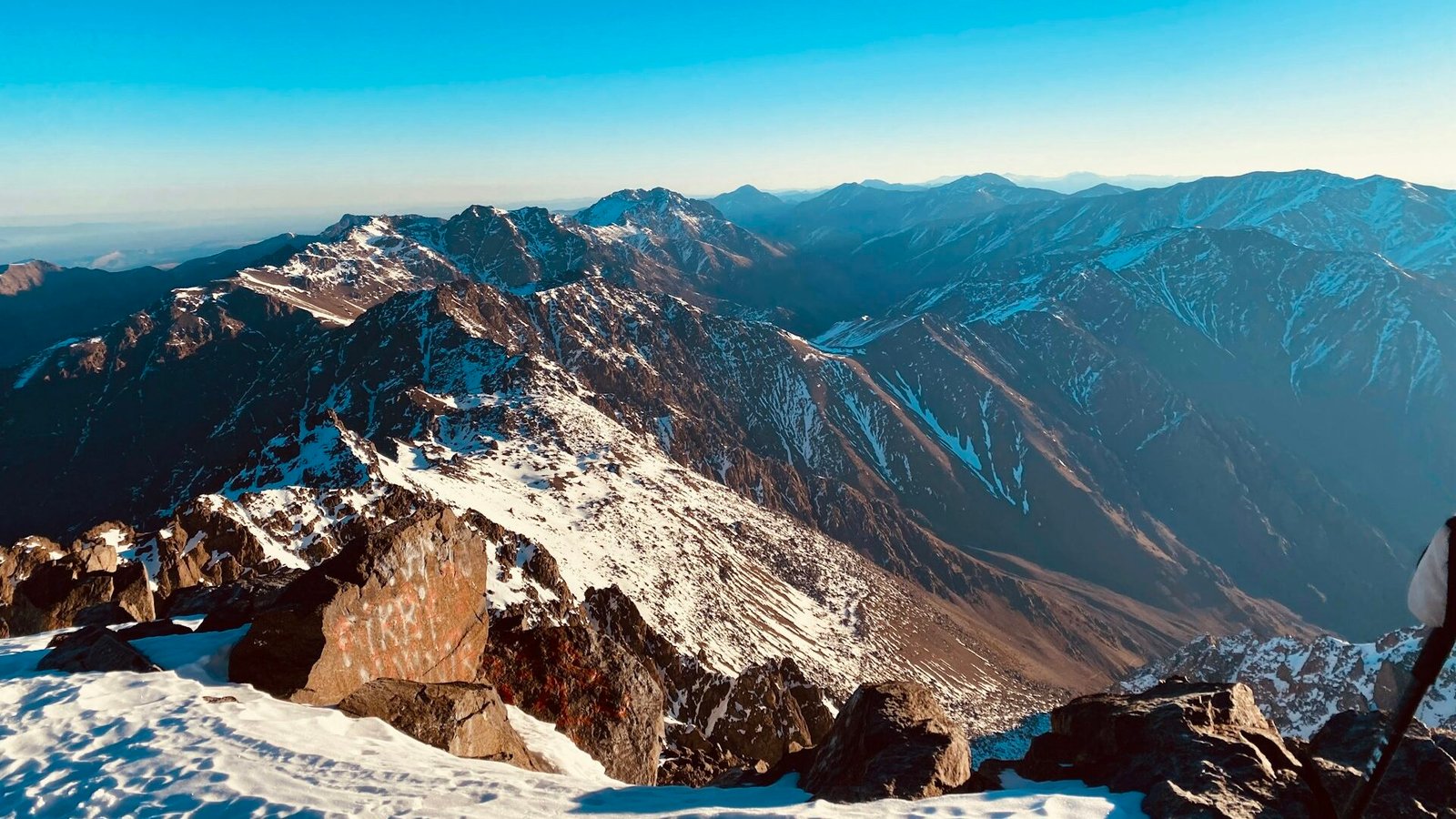
To climb Mount Toubkal (4,167 m), the highest peak in North Africa, you drive about 65 km from Marrakech to the village of Imlil (around 1,740 m), walk five to six hours up the valley to the Toubkal Refuge (about 3,200 m), then set off before dawn for a three-to-four-hour ascent to the summit. Most people do it in two or three days with a licensed local mountain guide, which is now compulsory, and from April to October no climbing skills are needed, only good fitness.
Key takeaways
- Route: Imlil (about 1,740 m) – Aremd – Sidi Chamharouch – Toubkal Refuge (about 3,200 m) – summit (4,167 m) by the south cirque, and back the same way.
- 2 or 3 days: two days suits fit, experienced hikers; three days adds a second refuge night for acclimatisation and a spare weather window.
- Season: April to October is the non-technical season; from about December to March the upper mountain is under snow and ice and needs crampons, an ice axe and winter experience.
- Guide rule: trekkers in the Toubkal massif must be accompanied by a licensed mountain guide, who also handles registration, refuge beds and mules.
- Effort: summit day climbs roughly 950 m from the refuge and, on the 2-day plan, then descends about 2,400 m to Imlil.
Where is Mount Toubkal?
Jbel Toubkal rises in the High Atlas about 65 km south of Marrakech, at the heart of Toubkal National Park. The usual starting point is Imlil, a Berber village of stone houses among walnut and apple orchards, from where a mule track climbs the Mizane valley to the refuges below the summit.
In the snow-free season Toubkal is a walking peak, not a climbing one: the normal route has no ropes, ladders or exposed scrambles. What makes it demanding is the altitude, the loose scree and the length of summit day. On a clear morning the view stretches across the High Atlas to the Anti-Atlas and the Jbel Siroua volcano.
2-day vs 3-day Toubkal climb: which should you choose?
Both itineraries follow the same path to the same summit. The difference is time at altitude and slack for the weather.
| Aspect | 2-day Toubkal trek | 3-day Toubkal trek |
|---|---|---|
| Nights at the refuge | 1 | 2 |
| Day 1 | Marrakech – Imlil – refuge, about 5–6 hours on foot | Marrakech – Imlil – Aremd – refuge, about 5 hours on foot |
| Summit day | Start around 5:30, about 4 hours up, then all the way down to Imlil and back to Marrakech by about 17:00 | About 3 hours up and 2.5 hours down to the refuge, with a free afternoon to rest |
| Day 3 | – | Easy descent to Imlil (about 4 hours), lunch, drive to Marrakech |
| Acclimatisation | Minimal: one night at altitude | Better: two nights at altitude |
| Weather margin | None | Extra time if the summit has to wait |
| Best for | Fit, experienced hikers with little time | First-timers and anyone who prefers a steadier pace |
If you are short on time and already hike regularly in the mountains, the 2-day Mount Toubkal trek works well. For most first-time visitors we recommend the 3-day Toubkal trek with two refuge nights: summit day feels noticeably easier once you have slept at altitude, and you come down without rushing. For the best possible acclimatisation, the 6-day Toubkal circuit via Lac Ifni loops around the massif over high passes and reaches the summit on the last morning.
The Toubkal route, stage by stage
Marrakech to Imlil (about 1,740 m)
Pick-up is early from your riad or hotel, and the drive via the Moulay Brahim gorge takes roughly 90 minutes. In Imlil the muleteers load your main bag, the food and the equipment, and you set off with only a daypack.
Imlil to the Toubkal Refuge (about 3,200 m)
The first hour leads through terraced fields to Aremd (around 1,900 m). The trail then crosses a wide stony riverbed and climbs to Sidi Chamharouch (around 2,250 m), a pilgrimage hamlet around a white-painted shrine and a usual stop for lunch or mint tea. Above it the valley turns barer and steeper, and after five to six hours you reach the refuges. This first day gains about 1,450 m, so take it slowly and drink often.
Two refuges stand side by side at this spot. Both offer dormitory bunks with blankets, shared bathrooms and a dining room; in summer your team may set up tents instead when the dormitories are full. Dinner is early, because the alarm goes off long before sunrise.
Summit day: refuge to 4,167 m
After breakfast at around 5:00 you start walking by headlamp. The normal route climbs the south cirque: first a steep section of boulders and scree just above the refuge, then a long, steady ascent to a col on the summit ridge, and finally a short walk to the metal tripod that marks the top. Allow three to four hours for the roughly 950 m of ascent. The air is thin and cold at dawn, even in July, so warm layers, gloves and a hat are essential. On the summit you usually have time for photos and a rest before heading down.
The descent
You return by the same path to the refuge for lunch. On the 2-day plan you continue straight down to Imlil, a descent of about 2,400 m in a single day that tests the knees more than the lungs; trekking poles help a lot. On the 3-day plan you rest at the refuge and walk down the next morning.
When is the best time to climb Toubkal?
- April to June: long days and green valleys. Snow often lingers on the upper slopes in April and sometimes into May, so your guide checks conditions and gear before you leave.
- July and August: the most popular months. Imlil is pleasantly cool compared with Marrakech, but the trail is busier and afternoon thunderstorms can build over the peaks.
- September and October: often the most settled weather of the year, with clear mornings, cooler nights and fewer people on the trail.
- November to March: winter conditions, with snow and ice on the upper mountain and short days. A winter ascent needs crampons, an ice axe and previous winter experience, so talk to us before planning one.
How fit do you need to be?
You do not need climbing experience, but you do need stamina. If you can hike five or six hours in hilly terrain and get up the next day to do it again, you are in good shape for Toubkal. Two to three months of regular cardio, such as running, cycling or brisk hill walking, plus a few long hikes with a daypack, is good preparation.
Altitude affects people differently, whatever their fitness. A mild headache or poor sleep at the refuge is common; walking slowly, drinking plenty of water and a second night at altitude all help, and your guide will slow down or turn back if symptoms become worrying.
Guide rules, permits and registration
Since 2019, Moroccan authorities have required trekkers heading into the Toubkal massif to be accompanied by a licensed mountain guide, and passports are registered on the way up. In practice you cannot simply walk up alone from Imlil. Your guide also books the refuge, arranges mules and permits and reads the mountain weather. Bring your passport on the trek, as rules can change and your guide will handle the current formalities.
What is included in a guided Toubkal climb
With Dream Travel Morocco, Toubkal is led by local guides from the Atlas under Mustapha Ait Benali, who has guided in these mountains for more than 15 years. A typical guided climb includes:
- Return transport between Marrakech and Imlil, with pick-up at your riad or hotel
- An experienced, certified local mountain guide
- Mules and muleteers to carry luggage, food and equipment
- All meals during the trek, plus snacks and water on summit day
- Your night or nights at the Toubkal Refuge
- Trekking permits and registration
Travel insurance, tips, drinks at the refuge and personal equipment are not included; the 3-day itinerary also covers hotel or riad nights in Marrakech. Prices are on request and depend on the season and group size.
Want more than the summit?
Warm up on the 3-day Berber villages trek around Imlil, combine two 4,000 m summits on the 8-day Toubkal and M’Goun trek, or get a first look at the valley on the Imlil Atlas Mountains day trip. Browse every route on our mountain trekking page.
Ready to stand on the roof of North Africa? Send us your dates, group size and hiking experience on WhatsApp at +212 606 957 514 or through our contact page, and Mustapha and the team will suggest the Toubkal plan that suits you, with a tailored quote.
FAQ
Most people take 2 or 3 days from Marrakech: one day walking from Imlil to the refuge, then a summit day of about 3–4 hours up and 2.5–4 hours down. The 3-day plan adds a second refuge night for acclimatisation.
Yes. Since 2019, trekkers in the Toubkal massif must be accompanied by a licensed mountain guide, and passports are registered on the way up. Your guide handles these formalities, the refuge booking and the mules.
It is non-technical from April to October but physically demanding because of the altitude, steep scree and long descent. Regular hikers with good fitness usually manage it, especially on the 3-day itinerary.
Yes, but conditions change completely. Snow and ice usually cover the upper mountain from about December to March, so crampons, an ice axe and previous winter mountaineering experience are needed.